
Verifying That a Redacted Document Hasn't Been Tampered With
You've redacted a document and shared it. The recipient questions whether the document has been altered since it was sent - whether content was added, removed, or modified after the fact. Without a verification mechanism, it's your word against their suspicion. Cryptographic verification certificates solve this by providing mathematical evidence of document integrity.
By RedactProof Editorial Team · 18 Feb 2026 · Updated 6 Sept 2026 · 4 min read
The problem verification solves
Once a redacted document leaves your organisation, you lose control of it. The recipient could modify it - intentionally or accidentally - and claim the version they have is the one you sent. In litigation, a party might argue that redactions were applied to hide relevant content rather than to protect personal data. In regulatory proceedings, an authority might want assurance that the documents provided are the same ones that were redacted.
Without a verification mechanism, there's no way to independently confirm that a document is unchanged from the point of redaction. Digital files carry no inherent tamper evidence. Unlike a physical document where alterations might be visible (different ink, paper texture, correction marks), a modified PDF looks identical to an unmodified one.
How cryptographic verification works
Verification certificates use public-key cryptography - the same mathematical foundation that secures HTTPS connections and digital banking.
When RedactProof generates a verification certificate, it creates a cryptographic hash of the redacted document. A hash is a fixed-length string derived from the document's content. Change a single pixel in the document and the hash changes entirely. The hash is then signed using an Ed25519 private key, producing a digital signature.
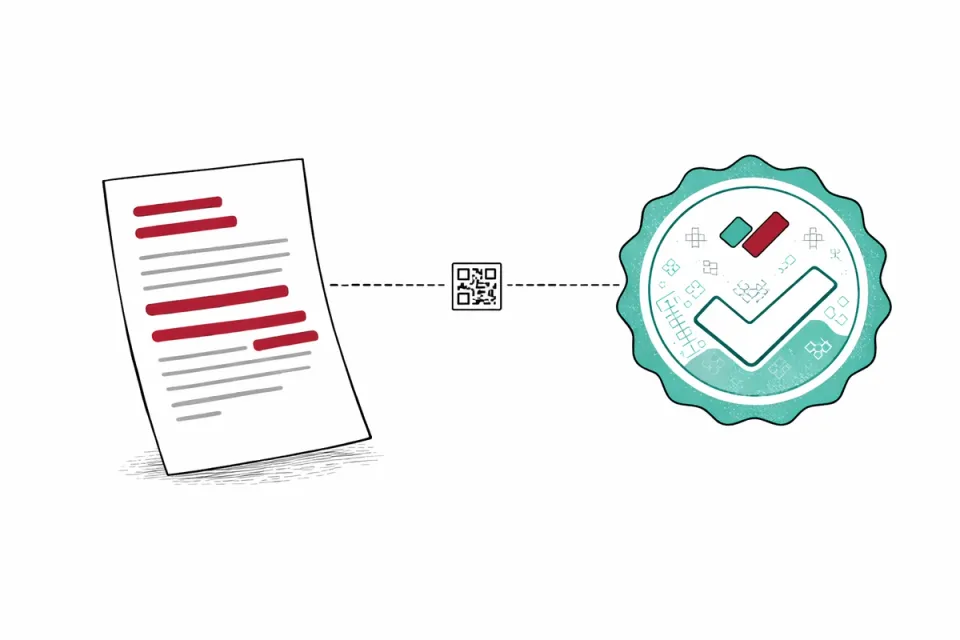
The certificate contains the document hash, the signature, and a timestamp. A QR code on the certificate encodes the verification URL. Anyone can verify the certificate by hashing the document themselves and checking the signature against RedactProof's public key. If the hashes match and the signature is valid, the document hasn't been modified since the certificate was generated.
No special software is needed for verification. The QR code links to a verification page where you upload the document to check it locally - the file doesn't leave your browser during verification.
When verification matters
Not every redacted document needs a verification certificate. Internal documents that stay within your organisation probably don't need one.
Verification becomes valuable when documents cross organisational boundaries: disclosure to opposing counsel, SAR responses to former employees, records provided to regulators, documents shared with insurers, or records submitted to tribunals.
It's particularly relevant in adversarial contexts. If someone has an incentive to claim a document was altered - and in litigation or regulatory investigations, they might - having cryptographic evidence of integrity pre-empts that argument.
Some organisations include verification certificates as standard practice for all external disclosure. The cost is negligible (it's automated) and the protection is permanent.
Integrity checks start before the export
A certificate can only vouch for the file that was exported, so the work of getting that file right happens earlier. One check worth knowing about: on scanned pages, RedactProof compares the document's embedded text layer against the printed pixels using text recognition. A layer that is out of register with the print is realigned automatically, and one that does not match what is printed is re-read from the pixels and flagged for review. That keeps redaction boxes anchored to the visible words before anything is burned, exported, or certified.
Limitations to know about
A verification certificate confirms that a document hasn't changed since the certificate was generated. It doesn't confirm that the redaction was done correctly, that the right content was redacted, or that the underlying process followed any particular standard.
The certificate is evidence of integrity, not evidence of quality. It answers "has this document been modified?" but not "was this document properly redacted?"
If the private signing key were compromised, an attacker could forge certificates. This is a theoretical risk shared by all digital signature systems and mitigated by key management practices. Verification certificates are one piece of evidence - useful and mathematically strong, but not a complete compliance framework on their own.
Create verified redacted exports
RedactProof generates Ed25519 digital signatures and SHA-256 hashes for every export on paid plans. Recipients can verify integrity instantly - no account required.
- Verification certificates - full guide to how certificates work and what they prove
- Compare plans - certificates included on Pro (individual and team seats).
- Security architecture - only hashes are stored server-side, never document content
Frequently Asked Questions
Can verification certificates be used as evidence in court?
Cryptographic evidence is increasingly accepted in legal proceedings, but its weight depends on the jurisdiction, the court, and how it's presented. Ed25519 digital signatures are a recognised standard in information security. The certificate itself documents the hash algorithm, the signing key, and the timestamp. Whether a specific court accepts it as evidence of document integrity is a question for your legal advisors. Having the certificate is strictly better than not having it.
What happens if someone modifies a verified document?
The verification will fail. When the modified document is checked against the certificate, the cryptographic hash won't match, and the verification process will report that the document has been altered since the certificate was generated. The certificate doesn't reveal what was changed - only that something was.
Do both parties need RedactProof to verify a certificate?
No. The QR code on the certificate links to an online verification page. The person checking the certificate uploads the document to that page, and the verification runs in their browser. The file doesn't leave their device. No account, subscription, or software installation is required to verify a certificate.
Related Documentation
Try it yourself
Put this into practice with RedactProof. Free account, no installation needed.