
How to Redact Contracts Before Sharing With Counterparties
Overlay redaction - drawing black boxes in Word or a PDF editor - leaves text selectable underneath. For in-house teams sharing contracts with counterparties, regulators, or courts, this guide covers what proper redaction looks like and where it typically breaks down.
By RedactProof Editorial Team · 1 May 2026 · 12 min read
This article is for general informational purposes only and does not constitute legal advice. Regulatory requirements vary by jurisdiction and change over time. Consult a qualified legal professional for advice specific to your organisation's circumstances.
A technology company is six weeks from closing an acquisition. The legal team needs to share the target's master services agreement with the buyer's external counsel - but the contract contains pricing schedules, named sub-processors, and earn-out mechanics that are subject to confidentiality restrictions. The in-house team cannot redact in a standard contract review tool because they don't have one. The procurement software doesn't do redaction. And the "draw a black box in Word" approach that someone tried once created a version where the text was still selectable underneath.
This scenario is unremarkable. In-house teams routinely need to share contracts, board minutes, M&A documentation, and litigation files with counterparties, regulators, and courts - and the redaction tooling available to them is often inadequate, expensive, or both. This guide covers the specific workflows where contract redaction matters, what typically goes wrong, and what a proper approach looks like.
Why the 'PDF blackout in Word' approach is a liability
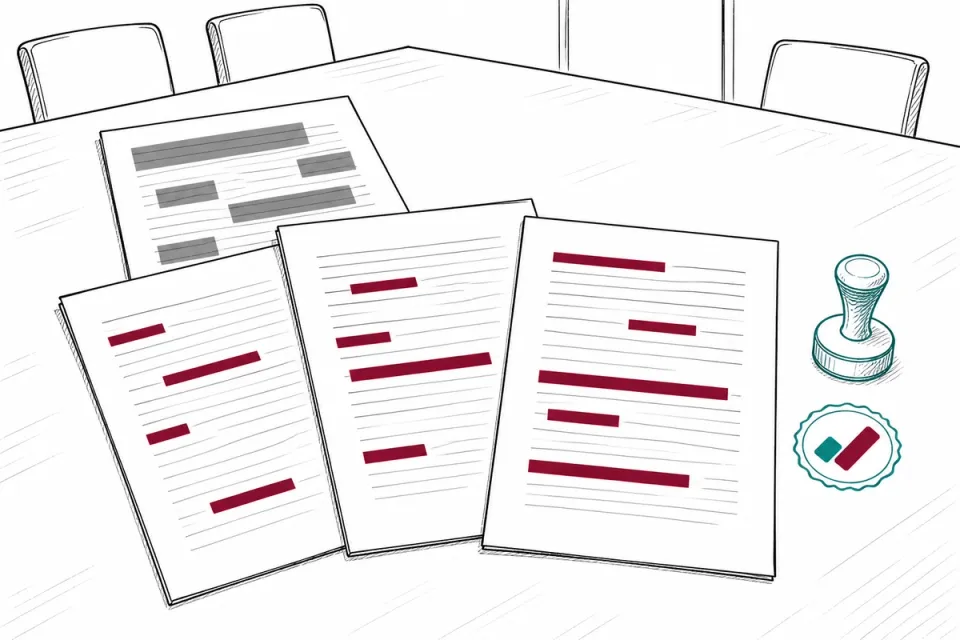
Most accidental data disclosures in shared contracts happen because someone used an overlay redaction method - a black rectangle drawn on top of text - rather than a method that permanently removes the underlying content. The distinction matters because overlay redaction doesn't delete anything.
There are three common failure modes. First: the recipient opens the PDF in a tool that ignores the overlay layer and reads the text. Second: the recipient uses 'Select All', copies the document, and pastes into a text editor - the text under the black box comes with it. Third: the file is later converted to a different format - Word, HTML, plain text - and the overlay disappears entirely.
This is not a rare edge case. Law firms, corporates, and government agencies have all faced enforcement action or embarrassment because overlay redaction failed. The ICO has noted in published guidance that visual masking without underlying removal is not an adequate redaction method under UK GDPR. In-house teams that treat Word drawing tools or basic PDF annotation as a compliance measure are carrying an undisclosed risk.
Pixel-burn redaction - which destroys the underlying text at file level - is the only method that actually works. Our guide to common redaction mistakes covers this failure mode in detail, including how to audit existing documents for overlay redaction.
Counterparty redline exchange
Commercial contracts shared during negotiation regularly contain information that cannot go to the other side: pricing from a different client relationship used as a reference point, sub-contractor identities subject to separate NDAs, internal margin calculations embedded in payment schedules, or deal terms from an earlier version of the same negotiation.
The challenge is that most in-house teams share contracts in formats designed for collaborative editing - tracked changes, comments, revision history. Each of these is a potential disclosure vector. Revision history in a Word document can reveal earlier deleted text. Comments sometimes contain internal strategy notes that were never cleared before sharing. Track changes may show the progression of a negotiation position that one party would prefer not to disclose.
Before a contract leaves the organisation in any format: accept or reject all tracked changes, strip comments, and clear document properties and metadata. If exporting to PDF, redact any content that requires removal before generating the final file - not after. Redacting a PDF after export is the correct sequence only if the original was a scanned document or a third-party PDF. For documents you control, redact at source.
For repeat counterparty exchanges - standard terms, framework agreements, template licence structures - the legal operations team can maintain a template redaction decision log: a standing record of which fields are redacted for which counterparty category. This prevents the same decision being made ad hoc by whoever is under pressure on a given day.
Regulatory disclosure and FCA/SRA enquiries
When a regulator requests documents, in-house teams often face competing pressures: the obligation to cooperate, the risk of over-disclosure, and the need to protect legally privileged material. The SRA and FCA both have powers to require document production, but neither requires firms to produce material outside the scope of the specific request, nor to produce privileged communications.
The defensible approach in most regulatory responses is to produce documents with three categories of material removed: information clearly outside the scope of the request, third-party personal data not relevant to the matter, and legally privileged material. Each category of redaction should be logged and identified to the regulator. Silent redaction - blacking out text with no accompanying explanation - is generally not considered cooperative by regulators and may prompt follow-up requests.
Legal professional privilege survives a regulatory request. It is not waived because the FCA or SRA asked for the document. The standard approach is a privilege log: a schedule noting each withheld item, the nature of the advice sought, and the identity of the legal advisor - without disclosing the privileged content itself. Privilege claims are routinely challenged in regulatory proceedings, so a contemporaneous log prepared at the time of redaction is considerably more defensible than a retrospective claim.
For broader guidance on redaction in regulatory and disclosure contexts, our guide to redacting documents for disclosure covers the DSAR and FOI workflows in detail.
M&A data room preparation
Data room preparation is where in-house contract redaction is most systematically required. A buyer's due diligence review will access hundreds or thousands of documents - customer contracts, supplier agreements, employment terms, IP licences, property leases - and most of those documents contain information that needs to be withheld from the buyer's team until the deal reaches an appropriate stage, or altogether.
The redaction decisions in an M&A data room typically fall into several categories:
- Customer names and counterparty identities - where the target company's customer relationships are subject to confidentiality clauses or where disclosure to the buyer would create a commercial risk before signing
- Commercially sensitive pricing - unit prices, margin data, rebate structures that are not material to the deal valuation but would be useful to a competitor or create post-deal leverage
- Personal data of individuals not relevant to the due diligence scope - employee payroll details, health information, contact data beyond what is needed to assess headcount
- Information about third-party disputes or litigation not disclosed to the buyer as a deal risk
The common mistake is treating data room redaction as a one-time manual task done under time pressure. In practice, large deal teams use a tiered disclosure approach: an initial data room with heavy redaction, then progressive disclosure as due diligence advances and non-disclosure agreements are signed at senior levels. The redaction decisions for each tier should be documented in a disclosure schedule, both because the buyer may challenge withholding and because the same schedule becomes a negotiating anchor for representations and warranties.
AI-assisted redaction tools that can process large document sets are increasingly standard in enterprise-grade virtual data rooms. For in-house teams running deals without full eDiscovery infrastructure, browser-based tools that process documents locally - without uploading files to a vendor server - provide a practical alternative. RedactProof's AI detection identifies 40+ PII types automatically and processes documents in your browser, which means the documents themselves never leave your control. At the deal volume typical for mid-market M&A, that removes a meaningful data room security exposure.
Board minute disclosure
Board minutes present a specific redaction challenge because they often contain legally privileged content (reports from legal counsel on litigation risk, regulatory matters, or M&A strategy) mixed with ordinary commercial decisions, and because multiple parties may have a legitimate interest in different parts of the same document.
When board minutes are requested as part of a regulatory enquiry, disclosure to a counterparty in litigation, or in connection with a share sale or refinancing, in-house counsel typically needs to produce a version that removes privileged passages, third-party personal data, and information about unrelated matters. The challenge is that board minutes are rarely structured to make these separations clean - privileged legal advice is often embedded in the middle of a commercial discussion, not in a clearly delineated section.
Redacting board minutes properly requires a document-by-document review. It cannot be automated without human sign-off on each decision. The practical workflow is to generate a redacted PDF with each removed passage replaced by a placeholder that describes the category of withheld content - for example, '[Legally privileged - in-house counsel advice]' or '[Third-party personal data - employee name]'. The placeholders make the redaction structure visible to the recipient without revealing the withheld content, and they demonstrate that the redaction was deliberate.
Litigation hold and disclosure obligations
When litigation is contemplated or underway, in-house teams face two simultaneous obligations that can pull in opposite directions: the duty to preserve documents relevant to the proceedings, and the need to ensure that anything disclosed to the other side has been reviewed for privilege, confidentiality, and relevance.
UK civil procedure (CPR Part 31) requires standard disclosure of documents a party relies on and documents that adversely affect their case or support the other party's case. Documents produced in disclosure must be provided in their original form - you cannot redact simply to remove unhelpful content. But privilege is a genuine basis for withholding, and confidential third-party information can sometimes be redacted where it is genuinely irrelevant to the proceedings.
The standard process for disclosure redaction in litigation involves preparing a list identifying every document disclosed, any document withheld on privilege grounds, and any document produced with passages redacted - together with the basis for each withholding. Opposing counsel will scrutinise this list. Redaction decisions that cannot be justified with a clear legal basis will be challenged, and courts have ordered the production of purportedly privileged documents where the privilege claim was inadequately supported.
For in-house teams without dedicated eDiscovery tooling, the practical constraint is less about document volume and more about the review workflow. Browser-based redaction with automated PII detection significantly reduces the manual review time. For more on compliance team disclosure workflows, see our guide to document redaction for compliance teams.
Tooling for in-house teams
Enterprise eDiscovery platforms - Relativity, Nuix, DISCO - are built for large-scale document review in complex litigation. They are appropriate for law firms managing multi-party litigation with hundreds of thousands of documents. For in-house teams running a data room preparation, a regulatory response, or a periodic M&A deal, the procurement, implementation, and licensing overhead rarely makes sense.
The alternative is not to return to Word drawing tools or Adobe's basic annotation layer. Browser-based redaction tools can handle the document volumes typical of in-house work without requiring IT procurement, vendor approval, or software installation. They run in any modern browser, which means a legal operations manager at a scale-up with no IT department can run the same workflow as an in-house team at a listed company.
RedactProof is designed for exactly this gap. Documents are processed in your browser - no upload to a vendor server - and the AI detection engine identifies personal data, financial identifiers, and other sensitive content automatically. Verification certificates with Ed25519 digital signatures provide a cryptographic record that the document was redacted at a specific point and has not been modified since. For deal teams and regulatory responses where chain-of-custody matters, that is a meaningful capability.
For a comparison of the tools available to legal teams, see our guide to the best redaction software for lawyers.
Frequently asked questions
Frequently Asked Questions
What is the difference between overlay redaction and pixel-burn redaction?
Do I need to tell a counterparty what I have redacted before sharing a contract?
Can we redact personal data from contracts produced in litigation disclosure?
Does attorney-client privilege apply to in-house counsel advice?
See it in action
Upload a document and let RedactProof find the sensitive data. Free to start, no card required.