
Court Filing Redaction: What to Remove and How to Get It Right
Court clerks reject filings, and judges issue sanctions when redaction goes wrong. This guide covers what UK CPR and US FRCP rules require you to remove, why the wrong tool creates real liability, and a practical workflow for consistent results.
By RedactProof Editorial Team · 1 May 2026 · 9 min read
This article is for general informational purposes only and does not constitute legal advice. Regulatory requirements vary by jurisdiction and change over time. Consult a qualified legal professional for advice specific to your organisation's circumstances.
Court clerks reject filings. Judges issue sanctions. And in the most public cases, redaction failures make headlines - not because firms were malicious, but because someone used the wrong tool or skipped a verification step. Preparing documents for court submission is one of the highest-stakes redaction tasks a paralegal or solicitor handles, and the rules are specific.
This guide covers what courts actually require, which information must be removed or partially redacted before filing, what happens when it goes wrong, and a practical workflow for getting it right consistently.
What the rules actually require
UK and US court filing rules approach redaction from different angles. In England and Wales, the primary framework is the Civil Procedure Rules (CPR). In the US, the Federal Rules of Civil Procedure (FRCP) apply in federal courts, with state courts maintaining their own equivalents.
England and Wales: CPR 5.4C and CPR 31
CPR 5.4C governs non-party access to statements of case. Under CPR 5.4C(4), courts can direct that documents only be made available in redacted form - but this requires a court order. You cannot simply redact a statement of case at your own discretion and file it; any redaction of the filing itself must be authorised by the court.
CPR Part 31 governs disclosure and inspection of documents in civil litigation. The general principle is that if material is relevant to the proceedings, it must be disclosed. Redacting on grounds of confidentiality alone is not straightforward - the EAT confirmed in Frewer v Google UK Limited [2022] EAT 34 that material necessary for the fair disposal of proceedings cannot be withheld merely because it is confidential. A court application with supporting evidence is required.
Legitimate grounds for redaction before filing include: legally privileged material, genuinely irrelevant third-party personal data, and material subject to a separate confidentiality order. In family proceedings, the Family Procedure Rules 2010 (FPR) apply, and practice directions under Part 21 set specific requirements for disclosure and redaction of personal information in care proceedings and financial remedy cases.
UK GDPR runs alongside CPR obligations. Where documents contain personal data of individuals who are not parties to the proceedings, organisations are generally expected to consider whether that data needs to be included at all - and if not, to remove it before filing. The ICO has issued guidance on data minimisation in this context. This is distinct from privilege-based redaction and does not require a court order.
United States: FRCP Rule 5.2 and Federal Rule of Criminal Procedure 49.1
FRCP Rule 5.2 is more prescriptive than its UK counterpart. It applies to any electronic or paper filing with a federal court and mandates specific partial-redaction of four categories of information:
- Social Security numbers and taxpayer identification numbers: last four digits only
- Dates of birth: year only
- Names of minor children: initials only
- Financial account numbers: last four digits only
Home addresses are also subject to partial redaction in some district courts - typically city and state only. Rule 5.2(b) allows a party to file an unredacted version under seal alongside the redacted public filing, with a reference list cross-referencing each redacted item to its full value. Federal Rule of Criminal Procedure 49.1 mirrors these requirements for criminal filings.
State courts vary. Many have adopted rules tracking FRCP 5.2 closely; others have additional categories. Always check the specific court's local rules before filing - federal district courts often have supplemental standing orders that go beyond Rule 5.2.
When it goes wrong: real cases
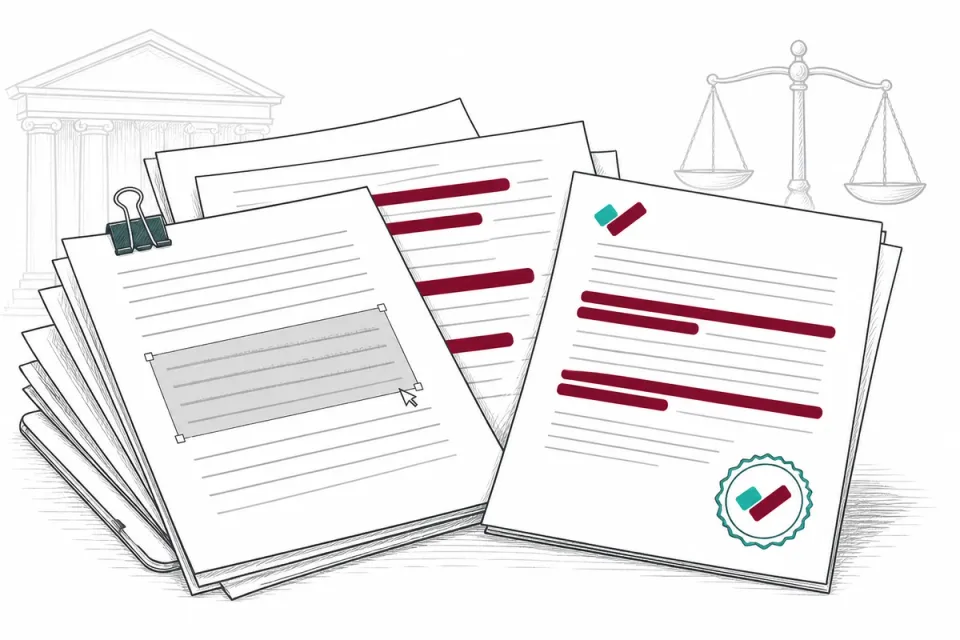
The most cited redaction failure in court filing history happened in January 2019. Paul Manafort's legal team filed a response to the Special Counsel's office that was intended to have several passages blacked out. Journalists discovered that copying and pasting the redacted paragraphs into a plain text document revealed the full underlying text. The "redactions" were black highlight boxes drawn over the text in Adobe Acrobat - an overlay method that leaves the text layer entirely intact. The filing revealed that Manafort had shared Trump presidential campaign polling data with a Ukrainian political consultant, Konstantin Kilimnik. The Department of Justice attributed the failure to a "technical error in the electronic redaction process."
A second well-documented pattern involves Social Security numbers appearing in CM/ECF (the federal courts' electronic filing system) without proper redaction. Courts have granted sanctions motions in cases where defendants failed to redact SSNs, financial account numbers, and dates of birth from filings, with courts noting that this placed protected personal information on an internet-accessible system. In these cases, courts have awarded attorney's fees related to the cost of bringing the motion to seal, and in more serious cases, ordered the documents returned for redaction and re-filing.
In the UK, the principle is illustrated by WH Holding Ltd v E20 Stadium LLP [2024] EWHC 817 (Comm), where the High Court considered the appropriate scope of redaction for non-party access under CPR 5.4C. The court confirmed that redaction can be appropriate but must be proportionate and properly applied for - it is not a default right. Over-redaction that removes material the other side is entitled to see is treated as a procedural failure with costs consequences.
Paralegal workflow for court filing redaction
This workflow applies to civil litigation filings. Criminal and family matters have additional requirements - consult your supervising solicitor or counsel for jurisdiction-specific steps.
- Confirm the filing jurisdiction and applicable rules. Check whether local court rules add to the baseline requirements of CPR or FRCP 5.2. Some courts have standing practice directions with additional redaction requirements.
- Identify the categories of information that must be redacted or partially redacted. For UK filings: privileged material, irrelevant third-party personal data, and material subject to a confidentiality order. For US federal filings: SSNs (last 4 only), DOBs (year only), minor names (initials only), financial account numbers (last 4 only).
- Run automated detection. Use a tool with AI-powered PII detection to identify SSNs, dates, names, and account numbers across all pages - including headers, footers, tables, and form fields where manual review commonly misses content. Review every suggested redaction; do not apply automatically without checking.
- Apply pixel-burn redaction only. Never use overlay methods (black highlight boxes, annotation layers, or drawn shapes over text). Pixel-burn redaction destroys the underlying text data permanently - the Manafort failure is the definitive demonstration of what overlay redaction costs when it reaches a court.
- Verify the redacted output. Open the exported PDF in a separate viewer. Attempt to select and copy text from behind each redaction mark. If readable text transfers to the clipboard, the redaction is overlay only and must be redone. Also check metadata: author, creation tool, document properties, and revision history should all be clean.
- For US federal filings: if the full information is needed for the record, prepare an unredacted version for filing under seal alongside the public redacted version. Create the reference list required under Rule 5.2(b) linking each redacted item to its sealed counterpart.
- Generate a verification certificate. A tamper-evident certificate provides a cryptographic record that the document has not been altered since export. This matters if the integrity of the filing is ever challenged - it provides documentary evidence of the document's state at the point of submission.
- Log the redaction decision. Record what was redacted, the legal basis, who approved it, and the date. If your redaction decisions are ever challenged - by the opposing party arguing over-redaction, or by a court considering sanctions - this log is your primary defence.
The mistakes that get filings rejected
Court clerks will reject filings for procedural redaction failures. The most common are: unredacted SSNs in CM/ECF filings, full dates of birth where only the year is permitted, and full financial account numbers in documents that should show only the last four digits. These are not edge cases - they come up regularly in practice, particularly in debt collection matters, probate filings, and family law financial statements where these data points are central to the claim.
Overlay redaction is the other category. A filing that appears properly redacted on screen may have intact text underneath - and any journalist, opposing counsel, or member of the public who downloads the document can reveal it in seconds. Courts treat this not as a minor technical issue but as a failure to comply with redaction obligations. The distinction between a good-faith technical error and a systematic failure to take reasonable care is one courts make explicitly when deciding whether to impose sanctions.
A less obvious failure: redacting the wrong version. In document-heavy litigation, it is common to work from an earlier draft. If redaction is applied to a document that has since been updated, or if the redacted PDF is replaced during a file-naming error, the wrong version reaches the court. Version control discipline - naming conventions, locked exports, and a verification step immediately before filing - prevents this.
Tools and verification
For litigation work, the minimum bar is a tool that applies pixel-burn redaction and lets you verify the output before filing. RedactProof processes documents in your browser - files are not uploaded to our servers - and exports include a tamper-evident verification certificate with an Ed25519 digital signature. The Pro plan includes an audit trail that documents every redaction decision and export, which is useful if a filing is ever disputed. See our guide to best redaction software for lawyers for a fuller comparison, or common redaction mistakes for the failure patterns we see most often.
If you're working through the redaction process from scratch, our how to redact a PDF guide covers the mechanics in detail.
Frequently Asked Questions
What information must be redacted from court filings in England and Wales?
Under the Civil Procedure Rules, there is no single mandatory redaction list equivalent to the US federal rules. Redaction before filing is generally appropriate for: legally privileged material, personal data of individuals not party to proceedings where that data is not relevant to the matter, and any material subject to a confidentiality order. Family proceedings under the Family Procedure Rules 2010 have additional protections, particularly around children's personal information. Consult your supervising solicitor for advice specific to the matter.
Can I be sanctioned for inadequate redaction in a court filing?
Yes. UK courts have costs consequences for procedural failures including improper redaction. Over-redaction - removing material the other side is entitled to see - can also attract costs orders, as confirmed in cases examining CPR 5.4C and CPR 31 obligations. The court generally distinguishes between a genuine good-faith error and a pattern of non-compliance. Either way, discovering the error quickly and correcting it promptly reduces exposure. General guidance only - not legal advice. Requirements vary by jurisdiction.
Why is overlay redaction a problem for court filings?
Overlay redaction places a visible black box over text without removing the underlying text data from the PDF file. Anyone who downloads the document can select and copy the "redacted" text into another application to read it. The Manafort case in January 2019 is the definitive example: black highlight boxes in a court filing were bypassed in seconds by copying the paragraph. Pixel-burn redaction permanently destroys the text layer, so there is nothing to recover. For court filings, only pixel-burn methods are reliable.
Do I need to keep an unredacted copy after filing a redacted document?
Yes. Retain the unredacted originals under your standard document retention policy. If your redaction decisions are challenged - by the opposing party arguing over-redaction, or by a court considering your compliance - you will need the originals to justify your decisions. Store them securely with the same access controls as other sensitive litigation documents, and keep a log of what was redacted and the legal basis for each decision.
How do I verify that a redacted document is safe to file?
Open the exported PDF in a viewer separate from the redaction tool. For each redacted area, attempt to select and copy the text underneath. If readable text transfers to your clipboard, the redaction is overlay only - the document is not safe to file and must be redone using pixel-burn redaction. Also check the document metadata (author, revision history, comments, embedded properties) for information that should not be in the filing. A verification certificate provides a cryptographic record of the document's state at the point of export - useful if the file's integrity is ever challenged after submission.
Related Documentation
Try it yourself
Put this into practice with RedactProof. Free account, no installation needed.