
What Counts as Personal Data - and What to Do About It
An HR administrator at a recruitment agency sends a reference to a new employer. The reference includes the candidate's name, date of birth, National Insurance number, and absence record. All of that is personal data - personally identifiable information (PII) - and all of it is regulated. Knowing what qualifies as PII is the starting point for handling it properly.
By RedactProof Editorial Team · 18 Feb 2026 · Updated 6 Sept 2026 · 4 min read
The legal definitions
The term personally identifiable information (PII) is used broadly, but different regulations define it differently.
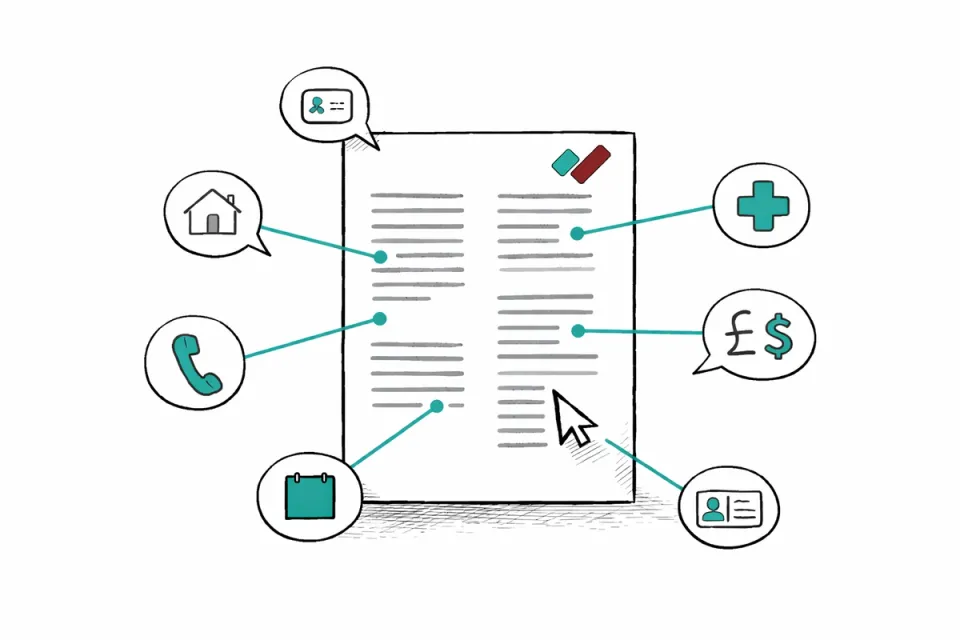
Under GDPR (which applies across the EU and UK via the UK GDPR), the term used is personal data: any information relating to an identified or identifiable natural person. Article 4(1) defines an identifiable person as one who can be identified, directly or indirectly, by reference to identifiers such as a name, identification number, location data, or factors specific to their physical, genetic, mental, economic, cultural, or social identity.
That's broad. A name is personal data. So is an email address, a phone number, or a National Insurance number. But under GDPR, personal data also includes less obvious identifiers - an IP address, a cookie ID, a vehicle registration plate, even a combination of seemingly anonymous data points that together could identify someone.
Under CCPA (California Consumer Privacy Act), the definition of personal information is similarly wide. It covers identifiers, commercial information, biometric data, internet activity, geolocation, employment information, and education records, among others.
The practical takeaway: if information could be used to identify a specific person, either on its own or combined with other available data, it's likely to qualify as personal data or PII under one or more regulations.
Categories that catch people out
The obvious ones - names, addresses, phone numbers, email addresses - are rarely missed. Organisations know these are personal data.
The categories that cause problems tend to be contextual or indirect.
Job title plus department can be identifying in a small organisation. "Head of Finance at [Company]" narrows to one person. In a multinational with 500 people in finance, it doesn't. Context determines whether it's personal data.
Dates are frequently overlooked. Dates of birth are clearly personal data, but appointment dates, absence dates, and transaction dates can be identifying when combined with other information in the same document.
Reference numbers. Employee IDs, case reference numbers, patient NHS numbers, student IDs - these are designed to identify individuals. They're personal data.
Location data. A home address is obvious. But GPS coordinates in a photograph's EXIF data, or a site visit log that records where someone was and when, are also personal data.
Financial information. Bank account numbers, salary figures, pension details, mortgage applications. A sole trader estate agent processing a property sale sees personal financial data from both buyer and seller.
Health and medical data. Under GDPR Article 9, this is "special category data" with extra protections. Absence records mentioning illness, occupational health referrals, prescription details - all qualify.
Why identification matters for redaction
When your organisation holds documents containing PII and needs to share those documents externally - through disclosure, FOI responses, SARs, or simply sending files to a third party - the PII that shouldn't be shared needs removing.
That's what redaction is for. The quality of your redaction depends directly on how well you identify PII in the first place. If you don't recognise a vehicle registration plate as personal data, you won't redact it. If you don't realise that a combination of job title and department name identifies someone, you'll leave it in.
Automated PII detection tools help with this. RedactProof's AI detection identifies 40+ categories of personal information, including less obvious types like medical record numbers, SWIFT/BIC codes, and address fragments. It's not a substitute for understanding what PII is - but it catches things that a manual reviewer scanning a long document at 4pm on a Friday will miss.
Practical steps for your organisation
If you're the person responsible for data handling in your team - whether that's your main job or something that landed on your desk - a few concrete steps help.
Map the document types your team handles regularly. For each type, list the categories of personal data they typically contain. An employment contract contains different PII to a property listing, which contains different PII to a medical referral letter. Knowing what to expect in each document type makes identification faster.
Train the team on non-obvious PII. Most people know that names and addresses qualify. Fewer realise that a staff rota showing who was absent on specific dates, or a project timeline naming individual contributors, contains personal data.
Use detection tools as a safety net, not a replacement for understanding. Automated detection catches most standard PII types reliably. It's less reliable with contextual identification - where data is only personal because of its relationship to other data in the same document. Human review remains part of the process.
DisclaimerThis guide is for informational purposes only and does not constitute legal, medical, or professional advice. Consult a qualified professional for advice specific to your situation.
Frequently Asked Questions
Is a business email address personal data?
Generally, yes. An email address like j.smith@company.com identifies a specific individual. Generic addresses like info@company.com or support@company.com typically don't. Under GDPR, the determining factor is whether the data relates to an identifiable natural person. If the email address points to a specific individual, it's personal data regardless of whether it's a business or personal account.
What's the difference between PII and sensitive personal data?
PII (or personal data under GDPR) covers any information that can identify an individual. Sensitive personal data - called "special category data" under GDPR Article 9 - is a subset that includes racial or ethnic origin, political opinions, religious beliefs, trade union membership, genetic data, biometric data, health data, and data about sex life or sexual orientation. Special category data has stricter processing rules and requires explicit consent or another specific legal basis.
Does anonymised data still count as personal data?
Truly anonymised data - where the individual cannot be identified by any means reasonably likely to be used - is not personal data under GDPR. But the bar for genuine anonymisation is high. If there's any realistic prospect of re-identification (even by combining the data with other available datasets), the data is pseudonymised rather than anonymised, and still qualifies as personal data. The ICO has published detailed guidance on the distinction.
Related Guides
Related Documentation
Redact with confidence
RedactProof detects PII across your documents without uploading them. Start with a free account.